My Teaching Purpose!
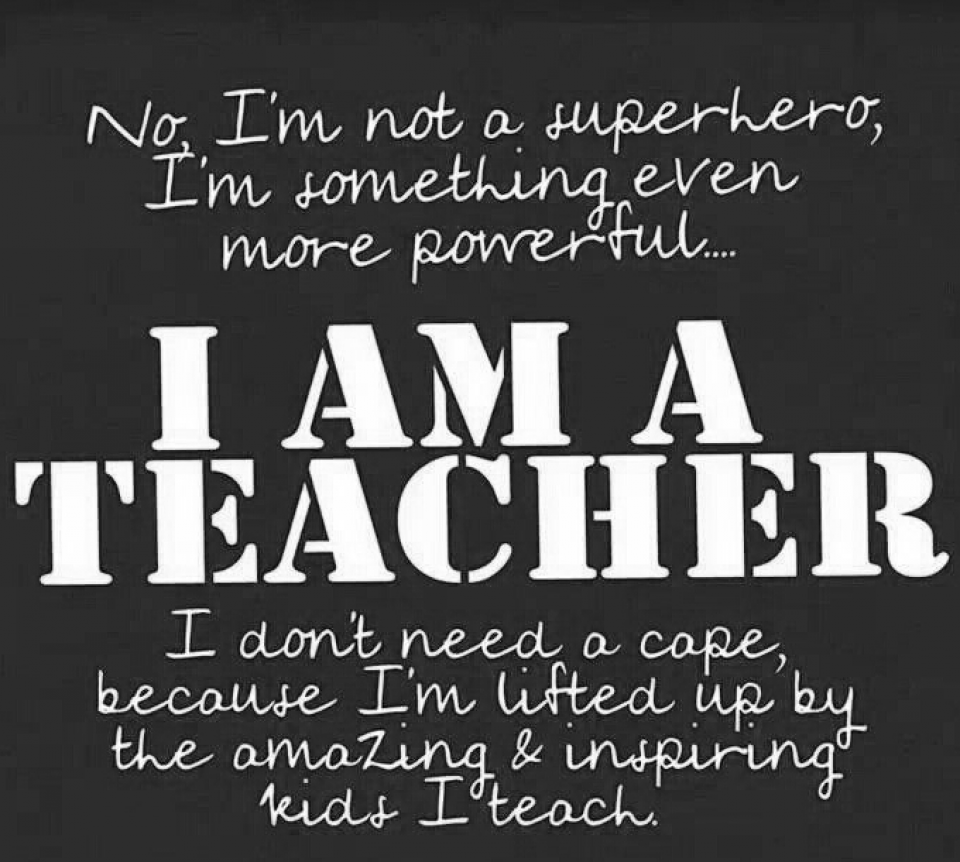
“No, I am not a superhero, I am somebody even more powerful
I am a Teacher, I do not need a cape because
I am lifted by the amazing and inspiring kids I teach”
This quote very well describes me as a teacher ,who is a cheerful and devoted person in general.. As a child I got inspired by my dad who was my hero and a source of great inspiration to me and just because he was a teacher too and was very popular amongst his students and had so many fans,I always wanted to be like him. At times I think that I am a born teacher just because being a student in elementary school, I always got picked up by my English language teacher as a group leader to review my group mates,which gave me enough confidence.
Two decades back, after finishing my college, I started working as an English language teacher at a home area school. I taught different age groups from grade 2 to grade 10. I always believed good teachers teach from hearts and not from books. I never taught for money’s sake; I taught for my love and passion for teaching. I was always devoted, hardworking and cheerful; just because of my positive personality and my warm language that I used, it made my students admire me. I always cherished the twinkle in my students’ eyes, their smiles, their appreciation notes, cards and oral praise by parents and colleagues. Soon I was awarded “best teacher” award. This motivated me to groom myself as a teacher and I joined part time studies and I completed my B.Ed. and ELT diploma. That added to my confidence and I designed two language activity books for my institute. As a teacher I always enjoyed my freedom in the class, how I had the opportunity to transform and influence my students. For a few years, I had the chance to experiment my teaching skills. To avoid burn out I always balanced my own time and my job hours and responsibilities.
If you ask me “what does teaching mean to me”, my answer is that it is my only passion! The interesting thing is time has proved that to the world I might be an ordinary teacher but to my students I am a hero and their inspiration as till day they are my best friends on Facebook.
My short term goals are to ignite my students’ love for learning, to bring my students’ intrinsic motivation into play, to make them enthusiastic learners and definitely to equip them with knowledge to pass exams.
My long term goals are to develop competence in my students, make them creative, help them think outside the box, to help them connect classroom learning to the real world, to make them fluent speakers of the language. All this effort will lead to their success in every field of life. They can not only pursue higher education with this but also become remarkable members of the society.
In short I think of myself as a transformer if I am given a chance to touch my students’ lives.
My Teaching Style
From the history of language learning, as a teacher I have learned a lot from all the various approaches. When we talk about grammar translation method, I would say it is good for adult learners as it gives a sense of confidence through intellectual exercises, but when it comes to the young learners it is not good at all just because this approach does not produce creative learners and fluent speakers. The four language skills i.e. listening/speaking/reading/writing are not well incorporated in the process of learning, spoken fluency is totally ignored which is the essence of learning a language. Individual differences and freedom of the learners is not taken into consideration. When it comes to writing composition, reading comprehension, answer questions, those are very effective to measure the understanding of the learners, so I like to use them in my class. When we take a look at direct approach that emphasizes on listening and speaking which is actually very good for learning a language. This approach encourages the use of aids likes posters, pictures, realia that helps the learner to visualize and connect to the target language. Mistakes, self-correction and trial & error are encouraged. Effective filter is kept really low which helps in learning. Berlitz method is a very good example in this regard and for the kind of results this approach produces, that is the reason I like it too.
Reading approach does not produce creative language users who can perform every day functional tasks e.g. writing an informal letter etc. It just provides passive knowledge of the language. But when it comes to reading techniques like skimming, scanning, extensive, guided reading, nobody can deny the importance of this method. Audiolingual approach brought the concept of boring drills that did not require any critical thinking on the part of the learner and we all know that learning phrases is not equal to learning a language; but somehow it provides pronunciation accuracy and the techniques they devised to measure listening and speaking are really good and can be used every now and then. It could be good for adult learners during a short learning course, it could help them learn every day phrases quickly which can save them time. As a teacher I do not mind using their drills as listening and speaking practice. The focus of cognitive approach is learners’ mind. This introduces the idea that errors are normal and what we can do about them is a way to understand the learner’s mind. As a teacher I cannot deny the importance and understanding of errors introduced by this approach. It helps me to change my strategies and make my content my more understandable for my learners.
When we talk about affective humanistic approach, that mainly focuses on learner’s comfort and wants us to provide soothing environment for students. They brought the concept of use of plays, games, dialogues; this approach gave us insight into how to remove barriers from learner’s experience. They encourage the idea of using food, music, posters, anything that could help in the learning of second language. For me it is really helpful to take help from their techniques to make my learner’s understanding crystal clear. Comprehension approach came in 1980. This introduced the idea of “silent period” and “comprehension”. Silent period allows the learners to proceed to the production stage at their own pace. This approach encourages the aid of visual aids and observable actions to produce comprehensible input. “TRP” plays a big role in this approach and I find it interesting and useful for my classroom too.
Communicative approach as the name suggests emphasizes on communication. It wants us to put learners in a situation where they can use the target language. Speaking language is way more useful than learning mere knowledge of grammar and vocabulary. In this approach levelled books are used. Authentic material, information gap activities, language games are the salient features that can be practiced on regular basis. Being a communicative teacher, I cannot just relate myself to one approach only. My philosophy is that using communicative approach along with techniques from grammar translation, reading approach, affective humanistic approach and comprehension approach because I guess I have to act more like a juggler, juggling with different balls at different timings, just to achieve the desired results and I feel that there is a lot to learn from all the approaches. Just because communicative approach alone can be good only in an English speaking context. Back in the days, I used to teach learners from elementary and middle level but now I am more interested in teaching adult learners just because I think I can connect to them very easily because of my nature and my expertise.
My Teaching Technique
Gone are the days when teachers ruled the classroom like dictators. Now things are different. The flipped model of learning does not want any sage on the stage. I have learned that students are not empty vessels that can be just filled with knowledge. As a teacher I keep fundamental principles of language teaching in view while planning and designing my lessons. I make sure that I use proper techniques to keep my learners engaged. To keep my students motivated, I use techniques such as warm teacher talk, body language and scaffolding because all these are helpful for a meaningful and interesting learning. In my class I always try to maintain 80/20 rule, keeping in view the input hypothesis and this is important because classroom is a place for conversation where the learners are to be given enough practice. It is not a place for my performance but for them to practice the language. I try my best to make material / content lively. In my class I try to keep eye contact with all my students. I keep monitoring their body language and their facial expressions to assess their willingness for learning. I try my best to keep my classroom interactive so that learners can play with the language as much as possible. Mistakes are allowed, freedom of trial and error is given. I make use of plenty of visual aids and realia so that my learners can feel connected to the language and so that the content becomes sticky for them. To make my lesson beneficial for my students, I keep Gagne’s events in view i.e.
- · Gain attention
- · Inform learners of objective
- · Stimulate recall of prior knowledge
- · Present the contents
- · Provide “learning guidance”
- · Elicit performance (practice)
- · Provide feedback
- · Assess performance
- · Enhance retention and transfer to the job
For warm up activities most of the time I draw something on the board or use probing questions, sometimes I make use of pictures, realia to ask questions and to stimulate the learner’s imagination. There are times when I share a story. For guided practice I use open ended questions or starter sentences, sometimes predictions, skimming, scanning during reading and while writing keep asking them questions to maintain the interactive element in my class, sometimes I ask my students to enact scenes from reading or videos. There are times when my students are asked to enact dialogues to practice language. For independent practice, I use traditional techniques like tests, composition, presentation, interviews, dramatization etc. TRP is also one of my favorites. All these techniques help me to focus on all the four language skills that makes my students practice language. For assessment, most of the time I try to do knowledge based assessment and not memory based and while evaluating my students I always make use of rubric and provide my students with list of error codes.
I try my level best to keep things conversational and make use of teaching tools like feedback. I try to supply my students with models from previous classes. Based on the formative assessments, I keep on revising my teaching strategies.

